Viscri village, a treasure of Transylvania
About Brașov, Rupea, Viscri, Sighișoara
Viscri, one of the most beautiful Saxon settlements in Transylvania, became known around the world after Prince Charles bought a home here and restored it, keeping all its traditional elements. The village also featured in the well-known documentary Wild Carpathia, and as a result the number of tourists who come to the area is impressive, passing 30,000 visitors a year.
The village has flourished and developed, including as a tourist destination, and is the favourite of many tourists from all over the world. In recent years guesthouses and restaurants have been built, where tradition takes centre stage. The fact that Prince Charles bought a house in the area certainly put the village on the map of Europe.
The locals did not hesitate to profit from this, and in 2012 Viscri jam was launched, made from wild berries and presented as a luxury product, with the jars wrapped in a silver fabric and delivered with a silver spoon. A jar of this jam costs 365 euros.
The Saxon architecture of the houses in Viscri, which has lasted for over 200 years, is delightful and very cheerful, with green, blue and cream as the dominant colours, decorated with floral bas-reliefs. One feature that attracts a lot of attention is the wooden shutters, as old as the houses themselves, painted so as to contrast with the walls.
The most important sight in Viscri is certainly the Fortified Church, built as early as the 13th century. Considered a true medieval architectural treasure, the church is surrounded by a citadel with defensive walls, two bastions and two towers. The church has been part of the UNESCO World Heritage since 1999.
You can visit the church, where you can admire traditional objects from the village displayed in the museum in its courtyard (traditional costumes, embroidery, a loom), or climb the church tower, from where you can enjoy a superb view over the whole area. According to the Telegraph, the place of worship is on the list of the most beautiful churches in the world.
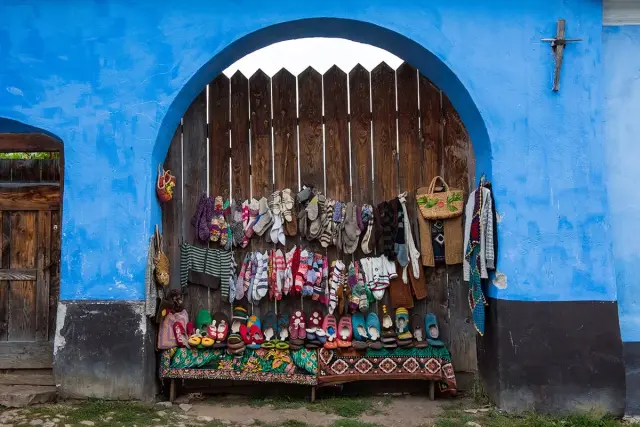
Crafts are at home in Viscri: spinning wool and knitting socks is quite a common pastime. Almost every gate in the village is decorated on the outside with pairs of natural wool socks, each more colourful than the last, striped or plain.
Viscri is the perfect example of how a village can become a tourist attraction at an international level, as long as traditions are preserved and valued. In fact, the houses in Viscri can no longer be altered, at least not significantly. As the village is part of the UNESCO heritage, the houses can be restored only in the local style and with local materials, the road remains paved with river boulders, and double-glazed windows are ruled out.
Do not miss a bike ride on the hills in the area, where you can admire the traditional character and cheerfulness of the place. Bicycles can be hired for a whole day.
Another interesting detail is that the guesthouses in Viscri have no names, and carry the name of the village and the number of the house: Viscri 32, Viscri 101 and so on. So you can stay in traditional rooms, where you will find all the amenities needed for your comfort. Do not miss a portion of food prepared according to the rules of slow food, from local ingredients, absolutely delicious (home-made noodle soup, sour cherry tart and home-made sausages are among the specialities of the area).
Photo credits: Unsplash