Interesting Facts About the Danube Delta
About Sulina, Mahmudia, Murighiol, Dunavățu de Jos and 2 places more
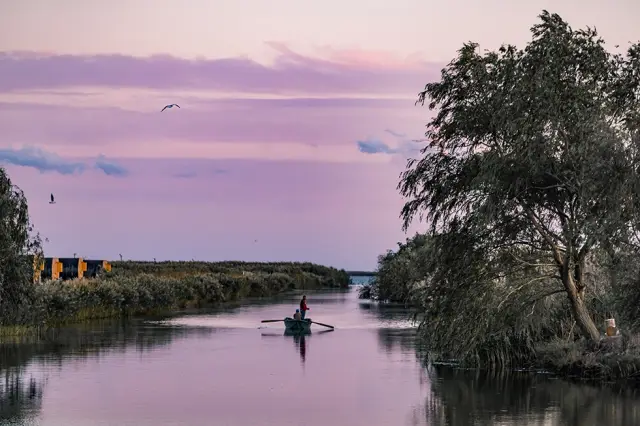
We can consider ourselves a lucky people, being able to enjoy and admire up close one of the best-preserved deltas in Europe. An oasis of calm you would never want to leave, a true paradise of nature, the Danube Delta is one of the most important tourist destinations in Romania, which year after year attracts an impressive number of tourists.
A trip to the Danube Delta is “essential” for any travel lover, an opportunity to gain an impressive store of knowledge. Here are some facts about the Danube Delta:
- The Danube Delta is the third largest on the continent and 22nd in the world. Its territory grows by about 40 square metres a year.
- The Danube Delta is home to over 5,500 species, of which 1,800 are plant species, most of them protected by law in the country.
- The town at the lowest altitude in Romania is Sulina, the only town with a port on both the Danube and the Black Sea.
- It is the only delta in the world declared a biosphere reserve, since 1990.
- The Sfântu Gheorghe arm is the oldest arm of the Danube, and is over 100 kilometres long.
- In the Delta we find the lowest population density in the country, one inhabitant per 30 ha.
- This is also where we find Romania’s only sand forests: Letea Forest and Caraorman Forest, whose lianas can reach 25 metres.
- Letea Forest is the northernmost subtropical forest in the world.
- In Caraorman Forest is the oldest oak in the country. Also known as the “kneeling oak”, it is about 400 years old and has a diameter of 3.8 metres.
- The longest-lived animals in the Delta are the land tortoise and the water tortoise. They can reach the age of 120.
- A species protected in Europe is the Caspian whipsnake (șarpele rău), one of the most aggressive species in the Delta, and also the longest on the continent (it reaches a length of 2 metres)
- The smallest bird is known as the warbler (pitulice), 10 cm long and weighing 13 grams.
- The largest bird in the Danube Delta, on the other hand, is the Dalmatian Pelican, whose wings span 3.2 metres.
- The largest fish caught in the delta was a beluga sturgeon of 882 kg, in 1980 at Sfântu Gheorghe. In fact, the beluga is the largest freshwater fish in the world, and can live up to 100 years.
- This is where you will find the largest area of compact reed on the planet, stretching over 1,560 square kilometres.
- A true paradise for ornithologists, the Danube Delta is home to over 300 species of migratory and resident birds: egrets, swans, ducks, geese, cormorants and pelicans – the emblematic birds of the Danube.
- A paradise for fishing lovers, the Danube Delta also has two museums on the subject: the Fisherman’s House at Mahmudia and the Lotcoo Museum at Mila.
Read also: What can we visit in Murighiol, Danube Delta?