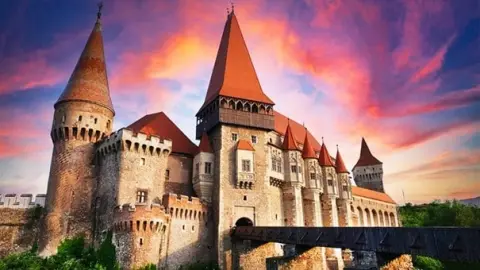
Corvin Castle – A Remarkable Tourist Attraction in Transylvania
About Hunedoara
With a history of more than six centuries, Corvin Castle is among the most representative tourist sights in Romania. Visitors to the castle are impressed by its beauty and by the legend that lives on around it.
In Hunedoara County, Corvin Castle has perfect architecture and is appreciated by tourists from all corners of the world.
It is one of the most important Gothic architectural monuments in Romania. Corvin Castle is among the 10 fairy-tale destinations in Europe.
Built in the 15th century on the initiative of Iancu de Hunedoara, on a rock at the foot of which flows the Zlaști stream, the Castle has undergone numerous transformations over the decades.
While at the time it was built it served as a strategic point and a feudal residence, in the 17th century certain parts of the castle were altered. Prince Gabriel Bethlen decided to build a two-storey wing over the old foundation.
Over the years, the castle’s owners left their mark on the monument, building new halls and rooms of honour.
Today Corvin Castle has been restored and serves as a museum, open to visitors.
Mystery hangs over Corvin Castle, a sight about which various ancient stories are told. The best-known legend is “the Legend of the Well”, according to which the well in the castle courtyard was dug by three Turkish hostages whom Ioan de Hunedoara kept captive in the castle. The nobleman promised to free them if the well had good water. Thrilled by the hope of freedom, they dug into the rock for more than 15 years and at 28 metres found the precious spring.
In all that time Ioan de Hunedoara had died, and his wife Elisabeta decided not to keep the promise made by her husband and ordered the prisoners to be killed.
Their last wish was to write on the keys of the well a phrase, “You have water, but no heart”, as a reproach for the broken promise.
The first sight that catches visitors’ attention is the New Gate Tower, whose rectangular shape is spectacular.
The Matia Loggia is at the exit from the Tower, on the left, with Renaissance influences standing out in its architecture.
Inside, several rooms are painted, and the Matia Wing has recently been renovated. The coats of arms of the Corvins have pride of place.
In the eastern part of the castle is the Chapel, reached by the inner staircase of the Loggia.
Corvin Castle stands out for the military architecture with which it was created, and is thus representative of the 15th century.
The numerous elements of civil architecture are admired by every visitor. The construction of the Great Palace is based on French influences, illustrating the grandeur of the Hunyadi family. Although the whole area at that time was dominated by Hungarian influences, the noble family drew on French culture and civilisation, which shows refinement.