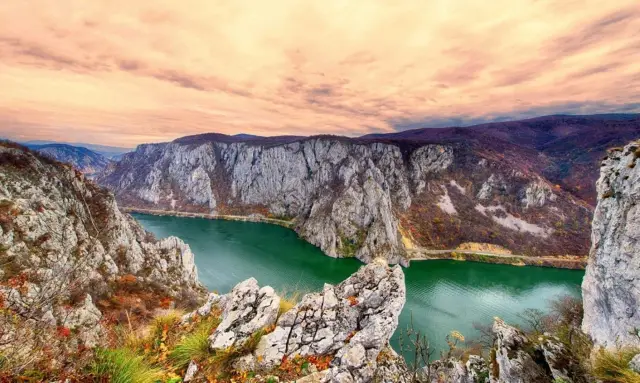
The town of Orșova is in the west of Romania, in the heart of Mehedinți County, on the Danube. Besides its advantage as a tourist destination, being right on the Danube, the town has a strong historical character and cultural and historical sights well worth discovering.
The view from the town towards the Danube is superb, letting tourists admire the natural beauty around it, on trails or on boat trips along the Danube Gorges.
We recommend a boat trip so that you can see up close the most beautiful and best-known sights in the area:
- Decebal’s Face measures 55 metres by 25 metres. It is a bas-relief carved into the rock, in the area of the Small Gorges of the Danube (Cazanele Mici). It is one of the largest statues in the world, on the same list as the Statue of Liberty in New York or the statue of Christ the Redeemer in Rio de Janeiro. Carving the bas-relief took 10 years (1994–2004) and was done by only 12 people. The costs came to one million dollars.
- The Tabula Traiana is a monument cut into the rock, which is as much as 2,000 years old. On the one hand it is said that the memorial plaque was set up by Emperor Trajan in honour of the Roman Empire’s victory over the Dacians in the second Daco-Roman war, and on the other that it marked the beginning of the suspended road built at Trajan’s request so that the Roman army could reach the area of Dacia. The Tabula is 4 metres long and 1.75 metres high and is set in the stone, with a depiction of two dolphins floating and an eagle in the sky.
- Ponicova Cave is the largest cave in the Danube Gorge and is located near the commune of Dubova. It is also known as the Bat Cave, the name coming from the colonies of bats that live in the Bat Gallery. The cave was declared a speleological reserve, and remains of Ursus spelaeus fossils were found here. The cave is up to 1,660 metres long.
- Mraconia Monastery is a spectacular sight with an impressive history. Also known as “the monastery under the water”, it is located near Decebal’s Face. Mraconia is said to mean hidden place or dark water. The place of worship dates from the 15th century and was unfortunately destroyed several times over the years (during the Russo-Austro-Turkish war of 1787 and 1792). It was demolished and rebuilt in 1968. But because it was covered by the waters of the Danube (hence the name Monastery under the Waters, Mraconia), it was rebuilt in 1993.
- Veterani Cave is known as the sanctuary of Zalmoxis, because the Dacians considered the cave a holy place of the god Zalmoxis. It is 87 metres long, and it can be reached only by boat, with the actual entrance reached by climbing onto a wooden pontoon. Inside the cave there is also a well, built by Turkish prisoners.
Do not miss a visit to this splendid town, known for its characteristic serenity and calm. A boat trip, a walk along the waterfront or in the town’s central park can be perfect occasions to relax and unwind, while you admire the play of lights and colours in a soothing setting.