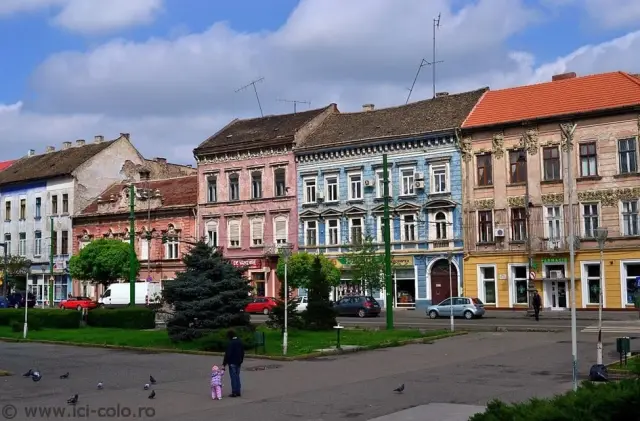
Being more of a transit city, Arad lies a short distance from the border with Hungary, and over time the city has been compared with several large European cities, which earned it the nickname Little Vienna.
Why visit Arad? It is simple: for its impressive cultural heritage, its superb historic buildings with a Viennese air, its citadels that played an essential role in past centuries and its wooden churches dating back to the Middle Ages.
Why this reference to Vienna? With its orderly, Germanic and somewhat sober appearance and historic buildings with their distinctive architecture, Arad manages to fit the picture typical of that European city.
Revoluției Boulevard runs through the old part of the city, where you can discover superb and imposing buildings on both sides of the boulevard. Among the most important are the Administrative Palace, built in Renaissance style in 1874, the Cenad Palace, the “Ioan Slavici” Classical Theatre, the National Bank Palace of 1906, and the “St Anthony of Padua” Church, a true Renaissance beauty, built as early as 1904. Cloșca Street has the most interesting houses, built in the 19th century, and on Horea Street you can admire the Neumann Palace, which was built on the initiative of the Neumann family of industrialists.
Avram Iancu Square, one of the most beautiful and important in the city, is surrounded by superb buildings in Baroque or Neoclassical style: Domany House, the Nádasdy Palace and the Pharmacists’ Palace.
Arad Fortress is a historic monument and one of the most important tourist attractions in this area. It was built over 20 years, between 1763 and 1783, in the shape of a six-pointed star, and served as a military prison during the Austro-Hungarian Empire. More than 1,500 families took part in its construction, and 169 houses were demolished. The prison’s best-known prisoner was Gavrilo Princip, who assassinated Franz Ferdinand, heir to the throne of the Austro-Hungarian Empire, the moment that signalled the start of the First World War.
Lunca Mureșului Natural Park covers an area of about 18,000 hectares and is home to over 200 species of birds and more than 1,000 plants that grow in the waters of the Mureș. It is included on the Ramsar list, along with 3 other areas in the country (Wetlands of National Importance). It is an opportunity for a trip on the water by boat, kayak or canoe, or a walk through the park, where you can admire the natural beauty and the peace typical of the place.
The Royal Castle at Săvârșin is an hour from Arad and has been opened to the general public. You can discover and admire what Queen Helen arranged with love and a great deal of involvement. The rural settlement was the favourite place of the Royal Family of Romania, where they almost always spent the holidays.